Thursday

Part 5


More searching

I called a well-known urological surgeon, and I also corresponded with him by email. I asked him to recommend someone really, really good.

This time I want a medical oncologist, or someone who specializes in treating cancer. I am referred to a physician at The Big Hospital who has an Ivy League med-school degree. Makes sense to me. I mean, you would want to go to The Big Hospital too, wouldn’t you? I have a solution! This is January 13, 2004. My PSA is 2.5, and the tumor mass in my lymph node is approximately 3 cm. Could be much worse.

Three appointments later I find that “this dog don’t bark” either. He is incredibly intelligent, and he knows a lot of research, but he talks down to me from Mt. Olympus and has learned to “always say ‘no.’” He has developed a standard protocol that protects him from lawsuits, and will go no further. Appointments are limited to 15 minutes, and as that time approaches you can tell he is impatient. I get no help, and he answers none of my questions. He thinks I’m a smart aleck, and I think he’s a pompous ass. This is in the spring of 2004. Leaving him behind, I start looking elsewhere. After the last appointment, I'm almost in tears from frustration.

This is where it gets really good.

Finally! An end to the search:

http://www.prostateforum.com/default.htm

If you need to know the facts about prostate cancer, and read in layman’s terms about all of the latest research, make this a prominent bookmark on your homepage and read everything on this website. Also, subscribe to the newsletter; I do.

This is my doctor--Dr. Charles Myers. He also has prostate cancer, and he is in remission. His PSA is less than 0.01. This is what I want.

In Part 6 I learn a very important rule.
Part 6

Rule number 3

In part 5, I discovered and met Dr. Myers, the prostate cancer specialist in Virginia.

I had read in his newsletter about how he had decided upon his own treatment from other specialists. (1) I was surprised to read that he, himself, had run into the same shortcomings from other physicians that I have described earlier and how dissatisfied he was, and (2) I was very interested to learn about how he approached his decision-making, with the help of his wife. Basically, it comes to this:

Rule number 3: You decide whether the treatment option or options are demonstrably effective, and if the side effects are not worse than the effects of the disease you are treating, then you must decide to go with the treatment.

I read that and thought that I had learned it.

Serendipity


Dr. Myers’ prostate cancer was very similar to mine, so I decided “what better example could I possibly follow?” It involved radiation therapy and also hormone therapy—reducing PSA to the neighborhood of <0.01, and then proceeding with a radiation treatment called intensity modulated radiation therapy, or IMRT.

It will be obvious why I chose it. I also met a really good radiation oncologist at St. Luke’s hospital in Chesterfield, Missouri, Dr. David Butler. He does his research, he shares it with me, and he answers all of my questions honestly. He doesn’t even mind a little debate. I consider him a friend. I met him because he was featured on the local news.

The other option was something called “3-D conformal radiation therapy,” a somewhat older method that Dr. Myers had undergone. I read about his side effects and his statement that were he to choose again—now that IMRT is an option—he would choose IMRT. So of course I did. I had 35 treatments, starting July 28, 2004 and ending September 16.

Just stay with me. Lots more equally important stuff to come in Part 7.

Tuesday

Part 7

A valuable insight

Hormone therapy (or Lupron shots) every 3 to 4 months are prescribed for me, depending on dosage, and cost anywhere from $2500 to $3000 a pop. Lupron shots "fool your body" into believing that is doesn't need to produce testosterone, the male hormone that causes prostate cancer to grow. Health insurance is a good thing. I pay almost nothing. Side effects from Lupron shots include “hot flashes” –just like your wife’s (although I think mine were worse), loss of muscle tone, and a thing called “emotional lability,” which means I will cry for any reason at all. Hot flashes are really unpleasant. The crying is, at worst, embarrassing. However, I eventually learned to control it.

I really learn to empathize with my wife. For the first time in my life, I understand what women deal with. Oddly enough, I also learn to listen instead of talk. This is appreciated by both of us and adds an entirely new dimension to our relationship. In adversity, I have gained much of value.

There is a standard protocol among most physicians for administering the first Lupron shot, because the first shot tends to produce what is called a “testosterone flare,” or a temporary increase in testosterone production. Obviously, I do not want this. A little white pill, called Casodex, is normally administered daily for a week before the shot; this prevents the flare. A good thing. However, I needed my first Lupron shot before I found Dr. Myers, so I returned to Dr. number 1; remember the movie star? A mistake on my part. He does not follow the protocol, so I will not take the shot in his office. I have my medical records transferred to me and tell his nurse that I won’t be back.

FYI: I find my medical records interesting reading; they contain information that I was not given, plus the occasional personal note from a nurse who does not like me. Well, I didn’t like her either. And anyhow, how is our relationship relevant to my medical treatment?


Shortly thereafter, his partner calls me at home. Wow, this is a first. He expresses concern that I am trying to treat myself. I reassure him that this is not the case and ask why I was not offered Casodex before Lupron. He says Casodex is very expensive. I think, “Excuse me? Who are you to decide what I should spend to take care of my health?” I don’t say it. I remain polite. On February 18, 2004, I go back to The Big Hospital and the Big Ego for the last time for my first Lupron shot. At least he knows what the proper protocol is, and I get the Casodex first.

See what can happen if you don’t do your own research? There is a lesson here, and its

Rule number 4: Do your own research

*&%#!, again!

Okay, so I have had surgery, hormone therapy, and radiation. Now what? I am really tired.

Still more to come. I don’t know it yet, but I am approaching a corner in Part 8 with some bad news on the other side.

Monday

Part 8


I am so glad I met Dr. Myers


Before I get to that corner, let me describe just 1 minute of my first appointment with Dr. Myers. Dr. number 1, the movie star look-alike, had prescribed a drug called “Megace” to control my hot flashes. The first day I took it the hot flashes disappeared. Hey, I’m happy!

Wrong. Dr. Myers tells me that the FDA is about to require a warning label on Megace—a “black-box warning”—that will basically state that Megace enhances the likelihood of osteoporosis.

I already have osteoporosis. What the hell? Do I really want to take a drug that will encourage it? Fortunately, for me, Dr. Myers is ready with a solution: an estrogen-containing cream that I rub onto my legs once a day. It bypasses the liver, so there are no metabolic dangers and it also stops my hot flashes. Happy again.

I take Fosamax once a week to reverse the osteoporosis.

I also started taking large doses (400 mg, twice a day) of Celebrex. If you are curious, go to Google and type in “PSA Celebrex” and see what you find. Celebrex works against prostate cancer independently of any other treatment and may enhance the effects of radiation therapy. In my view, my risk of cardiac problems is minimal compared with my risk from prostate cancer. You play the hand you’re dealt. Celebrex also has a beneficial effect against some types of colon cancer. I care about that, too.

Side effects from radiation therapy that I experienced were mild nausea, solved with soda crackers and Tums; extreme fatigue like nothing I had ever imagined—I couldn’t drive a car, there were times when I couldn’t even stand up—and severe leg cramps. I learned to love Ben-Gay; I learned to love my wife even more as she would massage my legs. The leg cramps could reduce a grown man to tears; I know. Also mild blistering at the bottom of my spine from what are called “dirty electrons,” or electrons that missed their target. Not many of those, and side effects were minimal compared with Dr. Myers’ experience. He required 2 years to recover from 3-D conformal radiation.

Note: most side-effects lag treatment by 2 to 3 weeks. Remember that. They sneak up on you.


Enough is enough, already!

In October 2004 I have a CT scan to verify that all visible evidence of prostate cancer is gone. We have been striving for this moment, and the news is great: no evidence of prostate cancer! (This doesn’t mean that I don’t still have it. Prostate cancer forms “micrometastases” in bone and lymph. The trick is to keep them at the “micro” level.)

We have succeeded. For now.

Up and down in 30 seconds

However, the same CT scan shows an “unidentified mass” in my sigmoid colon. (Well, if I didn’t have PSA tests, do you really think I had colonoscopies?) I tend to be consistent, even when wrong. Further investigation (a colonoscopy, which really isn’t bad at all) identifies it as colon cancer, a 4-cm mass 30 cm into the sigmoid colon.

Sigh.

I respond to this just like I responded to the prostate cancer: “get this thing out of me!”

On December 3, 2004, I have colon surgery. This is not a walk in the park. I will skip recovery except to note that it was “difficult.” That word condenses a lot. Fortunately for me, colon cancer is fairly well understood. I have, roughly, a stage II colon cancer, which means that the odds of my survival are pretty darned good.

But wait! There’s more . . .(Part 9)

Sunday

Part 9


Another “however”


Yeah. Well. In order to give me the best odds possible, chemotherapy is recommended.

I really don’t like this, because, in the world of prostate cancer chemotherapy is often an end-stage treatment, a delaying action. It works for a period of time, and then you may pass on to another level of existence. So “chemotherapy” has for me become an emotionally loaded concept.

I call Dr. Myers after having sent him some web-based research that indicated chemotherapy was not necessary for stage II colon cancer and asked his opinion. He reminded me of his approach to treatment: you choose the therapies that are most effective for you and compare their side-effects with those of the disease that you are treating. He then told me, in a way that I could not misunderstand, that dying of colon cancer was an extremely unpleasant process.

Okay, I know what I have to do. In January 2005 I begin chemotherapy with a combination of drugs. One drug, Eloxatin (a platin drug), is stopped after a few weeks because I begin to develop peripheral neuropathy. This is a strange feeling; my fingers are numb under the nail beds to some extent, and my feet feel like they are calloused, although I have no calluses. Weird. We continue with increased dosages of the other two drugs, leucovorin and 5-fluorouracil, which are delivered via “portacath” or portable catheter, surgically inserted in my chest with a very small tube running to my heart. A portacath is roughly the size and shape of a bottle cap. The treatment continued for 6 months. I finished on June 28 and await results next week. I highly recommend a portacath if you are going to have this kind of treatment. Beats the heck out of puncturing a vein every week. Ouch!

During this time, I begin to act a little “flaky”. Okay, maybe a lot “flaky”. Read Part 10 to discover another sneaky little . . .

Saturday

Part 10


There’s tired, and then there’s . . .

Roughly halfway through chemo, I begin just staring off into the distance for minutes at a time. Not surprising. Chemotherapy affects my brain as well as my body. I become slow to think and react, as well as, once again, very tired. This time, naps do not help; I am tired all of the time. Waking up is a chore; I can’t seem to get enough sleep. I’ve only just recovered from radiation therapy.

Chemo-brain,” as those of us in the know like to call it, is a very real, sneaky, little symptom. Effects are at first subtle. Eventually, I either notice (or have it pointed out for me) that I am no longer connecting my “mental dots” with any particular skill. I am slow to respond to questions, because I am reaching for information that just isn’t so easy to find anymore. I find that I lack the skills to drive, to program my video recordings, and even to keep up with daily conversations. I make decisions that are somewhat lacking
in sense.
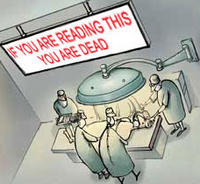

Rule number 5: Keep a sense of humor

In addition, I recall having “philosophical” discussions with my sons about what creates the unique personality. Lack of testosterone plus chemotherapy has a profound effect upon my personality and abilities. I know that I am different, but I can’t do anything about it. The thing to do is to make certain that the people closest to me are aware of it, too—(1) so they won’t worry about me, and (2) so they will help me function better.

I will need their help and understanding.

My wife tells me I am looking “pretty beat up” and gives me lots of hugs. Hugs help a lot.

My wife is an angel; she has never left my side during this whole experience. And at times it has been really ugly.

Rule number 6: Ask for and accept help. You can’t do this by yourself

At my most recent appointment, Dr. Myers notes that I’m showing signs of depression. I say, “no, I don’t feel depressed. I think I’m handling this okay.” And he tells me that what I’m experiencing is what he calls “medical battle fatigue.” And I think, “no kidding. I can buy that.” It is, actually, a type of posttraumatic stress disorder that occurs when you’ve maxed out—physically and emotionally. A mild antidepressant solves the problem.

Here is a neat thing if you are ever feeling depressed; it’s called Right Now. Click on the link below (works best with Internet Explorer 6) or copy and paste this into your browser:

http://dailymotivator.com/memberflash/rightnow.html
(Copyright 2001, Ralph Marston, Jr)

(Editorial note: You will want to turn your speakers on low, and you will probably need a recent version of Macromedia Flash. Internet Explorer works best, but if you are using a different web browser, you may need to install and run Apple's QuickTime and itunes. Click on the "back" button when finished.)

Rule number 7: Keep yourself in the now and don’t let your imagination defeat you

It’s been three surgeries, hormone therapy, radiation therapy, and chemo. Hormone therapy won’t last forever; eventually prostate cancer becomes “hormone refractory,” or resistant. I do not want to “teach” the prostate cancer cells to mutate, so I hope to stop Lupron shots in September of this year. Testosterone will, I hope, return to normal levels in several months, and my body will function at normal levels also. I may go on and off Lupron for years. I don’t know.

It beats the alternative and is a relative “piece of cake.” This has become my standard response to the query, “How’re you doing?”

"It’s a piece of cake.”

Well, sometimes, not always. . . . We'll talk about costs next.

Friday

Part 11


The lessons


At present, I am taking over 30 pills a day; I stopped counting at 30. The monthly pharmacy bill, if I had to pay it, approximates $2500. I hit my insurance deductible for the year in January, so prescriptions are free. The largest portion of this theoretical “bill” is for Casodex—3 pills once a day (cost: over $800 per month). Casodex is necessary to form another part of what is called a “triple hormone blockade or androgen blockade” because Lupron—by itself—will not stop all testosterone production. My plan A is to do this for 2 years and then switch to a pharmaceutical regimen that will keep the prostate cancer in remission.

Skip the costs for surgery and hospitalization. Understand that I can work from home part time and that insurance pays the balance of my income. Aside from all that, annual costs for pharmaceuticals (shots and pills), if I had to pay them, are around $30,000. Even if you have not been somewhat affected by the tales of surgery, hormone therapy, radiation therapy, and chemotherapy, that number should provide some motivation to see your doctor now. My insurance plan is exceptional, as is my work arrangement. Think of the damage that you may do to your family’s financial security . . . enough said? Drugs range from the esoteric—to repair capillaries damaged from radiation—to the mundane, like lycopene (extracted from tomatoes and other food sources).

Testosterone will, I hope, resume production; and I will be back to normal. I will continue to be obsessed with my PSA and have regular testing.

My final Lupron shot is scheduled for September 13 of this year. In December I hope to begin the regimen to put the prostate cancer in remission. The number of pharmaceuticals will drop from ~30 to a handful a day.

So here I am. On August 9, I will find out how I am. Six days ago, I began to feel like myself once again. I have been very fortunate. I can walk a half-mile to a mile at a time, and my mind is clear once again.

And I do have a plan B. And also a plan C. I’m serious.

Rule number 8: Get checkups regularly.

The most important rule of all. It’s the reason for this post.

Again, please, no sympathy. It’s not useful and I hate it. Also, please don’t think I’m courageous. I am not. I’m just stubborn and curious. And occasionally stupid.

I will not permit these diseases to end my life. I have a wonderful wife who continues to amaze me and who has always been my best friend, a grown family—from whom I now learn and of whom I am so very proud, and two grandchildren whom I would like to get to know so much better.

And I want to retire in 6 years!

I suppose I could have continued to keep all of this to myself, but I would like to give more meaning to what has happened.

I can’t give medical advice; but I can point you to resources and suggest emotional and mental attitudes that may serve you best. If you want to get in touch, feel free to email me. Start to protect yourself now.

Thanks for listening.

Rule number 9: Learn to be patient while awaiting test results.


I will let you know how things turn out.

Postscript follows.

Thursday


Postscript

Ann and I returned today from visits to the medical oncologist and the radiation oncologist.

Both of my cancers are in remission.

Note: The point of this entire exercise is to remove as many cancer cells as possible and then control what remains. In my case, I started with surgery; others, with appropriate advice, may choose some other method. I then followed with radiation therapy to treat a lymph node and an area near where the surgery was performed, called the "prostatic fossa." At the same time, I took and continue to take Celebrex because evidence indicates (1) it may enhance radiation thereapy, and (2) it has an independent effect upon prostate cancer. Third, I followed with what is called a "triple androgen blockade," which may kill much of the prostate cancer cells that remain. When this regimen is completed, I hope to control the whatever cancer cells may remain with a few pharmaceuticals, diet, and lifestyle changes. This is called remission.

Whatever means you choose, choose wisely.


I will, of course, continue to have the appropriate tests done at the appropriate times.

Get your PSA test and have a colonoscopy performed. They're simple.

Please do not risk going through what happened to me.

-John

Click here for next page.